

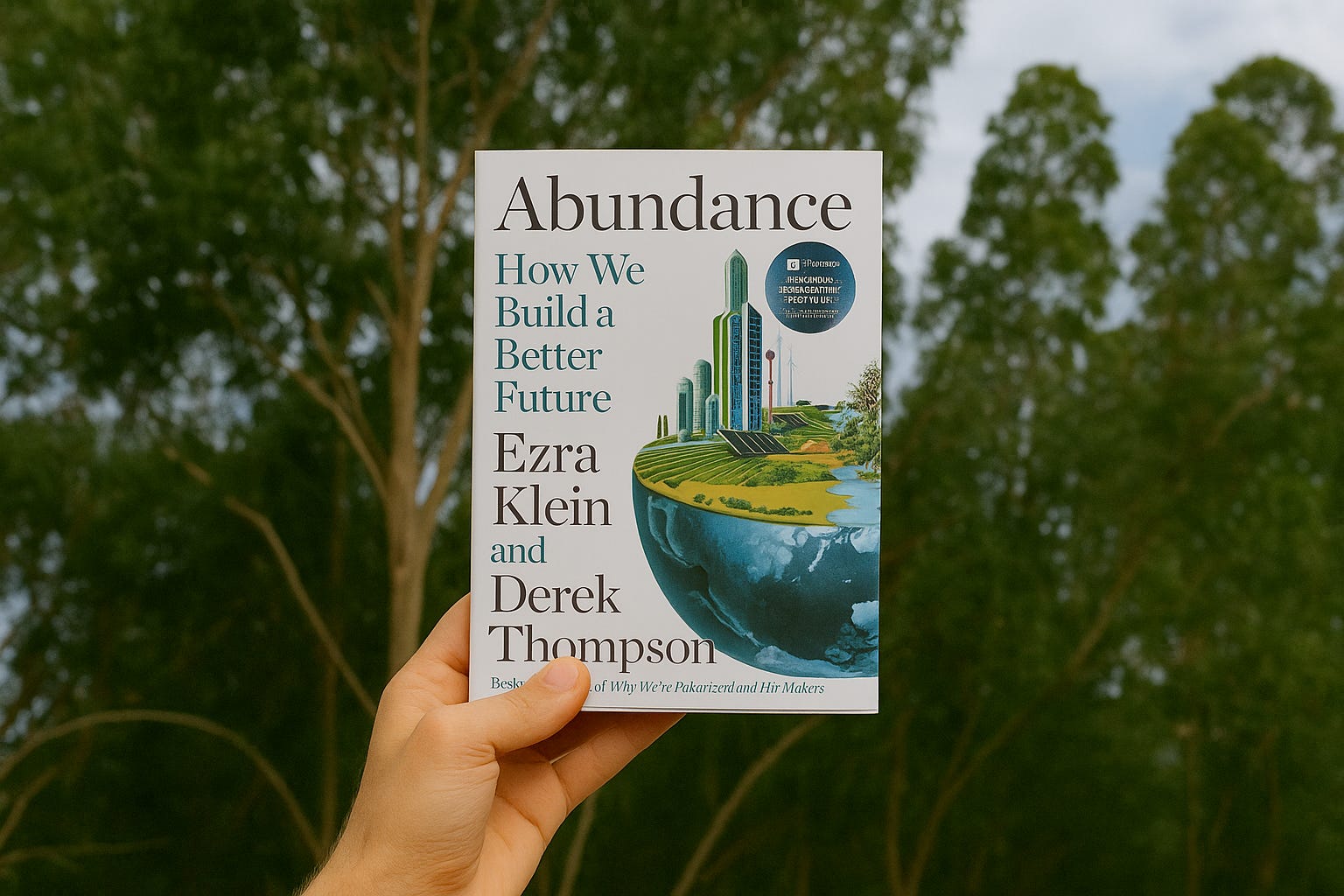
A lot has been written about Abundance since it was released in March 2025.
I found myself re-reading the book in August once it had well and truly entered the policy wonk and media mainstream.
Back in 2021, Klein and Thompson wrote (seperate) op-eds in the New York Times and Atlantic which set up the early Abundance themes. The book expands on these ideas, being pragmatic without being preachy.
Many reviews over the past 6-months have called Abundance ‘a manifesto for the left’ or ‘a rally cry to embrace supply side economics’. Noah Smith went as far to say ‘the basic thesis of this book is that liberalism — or progressivism, or the left, etc. — has forgotten how to build the things that people want’.
It seems Klein and Thompson have correctly identified that Democrats have over indexed on the ‘managing’, while almost entirely forgetting about the ‘making’. Not only is this bad retail politics, it’s a catastrophic approach to government.
I’ll explain.
Scarcity is a choice we make by failing to reform
One of the most pressing themes of the book is that the environmental reform of the 1970s’ and 1980’s was necessary for the time. But, that time has gone.
Modern day reform (and repeals of what was needed 40 years ago) is just as necessary:
One generation’s solutions can become the next generations problems. After World War II, an explosion of housing and infrastructure enriched the country. But without regulations for clear air and water, the era’s builders despoiled the environment. In response, the US passed a slew of environmental regulations. But these well-meaning laws to protect nature in the twentieth century now block the clear energy projects needed in the twenty-first. Laws meant to ensure that government considers the consequences of its actions have made it too difficult for government to act consequentially. Institutional renewal is a labor that every generation faces anew.
Retaining the reforms of 50-years ago dosen’t help us make progress today. Government (and I’d add the voting public) needs to update their priors.
Managers, not makers
I was asked recently why the north of England has such lower productivity (40 per cent in many areas) compared to London. Infrastructure was my first answer. Our ability to plan, finance, build, and maintain infrastructure underpins productivity growth. The slower we get at ‘making’ (including due to ticking many regulatory boxes), the more vicious the productivity trap becomes.
Klein and Thompson explain:
Now imagine dozing off for another thirty-year nap between 1990 and 2020. You would wonder at the dazzling ingenuity that we funneled into our smartphones and computers. But the physical world would feel much the same. This is reflected in the productivity statistics, which record a slowing of change as the twentieth century wore on. This is not just a problem for our economy. It is a crisis for our politics. The nostalgia that permeates so much of today’s right and no small part of today’s left is no accident. we have lost the faith in the future that once powered our optimist. We fight instead over what we have, or what we had.
Homes haven’t always been ‘assets’
The ‘financialisation’ of housing (or lack of a better term) seems age-old… but it’s really only been with us for 50-odd years. No where is this trend clearer than in Australia (and especially in capital cities). But the US has suffered a similar fate:
Prior to 1970, housing wasn’t a prime asset. You bought a home to live in it.
What impact has this had? Quite a bit:
In the ‘70’s, rising inflation and slowing home building turned the homes people did own into the center of their wealth. But how do you protect the value of that asset? You can insure a home against fire, but you can’t insure it against rising crime rates or local schools slipping in quality or a public housing complex being built down the block.
To manage those risks, you need to control what happens around your home. You do that through zoning and organising. You do it through restricting how many homes and what kinds of homes can be built near you…
It’s hard to look back nowadays and realise the current status quo wasn’t always the case. Klein and Thompson sum up the current state well:
Those who already lived in a place were its stewards, its guardians, its voice. Those who wanted to move to that place were recast as a consumptive horde.
NIMBYism isn’t just prejudice. It’s a rational financial strategy if the family home is both your store, and your engine, of financial security.
Think bigger on NIMBYism and democracy itself
Klein and Thompson make a strong argument that we’ve overcorrected on ‘challenge culture’ in building the physical world we need:
Changing the processes that make building and investing so hard now requires confrontations wth whether the systems liberals have built really reflect the ends they’ve sought. Much that was designed to foster grassroots participation has been captured by incumbents and special interests. It can be difficult, in a raucous town meeting, to look around and remember who is not there: the mother working two jobs, the young family who couldn’t afford the apartment they so badly wanted to move into.
It’s a long overdue reminder that the folks that have the ability (and to be frank, time) to participate in ‘challenge culture’ are usually those with means. This skews the infrastructure that gets built or maintained away from public transport, public hospitals, and public schools.
The 70’s green movement started as a legislative quirk
It was news to me that the original environmental movement in California started as a quirk out of the case Friends of Mammoth v. Board of Supervisors of Mono County.
A HOA sued to stop condos being built near a popular ski resort. The clever part of their argument was that while not a state project:
…yes, actually, it was, because any development that required public permits to be built was inherently a public project.
Friends of Mammoth lost the case in the lower courts but appealed up to the state Supreme Court, which ruled in their favor in a 6-to-1 decision.
The impact of this can’t be understated. All the environmental checks and balances designed to stop state projects trashing the environment now applied to any construction project in which the state regulates private activity (hint: that’s pretty much everything).
Klein and Thompson summarise:
The problem we faced in the 1970s was that we were building too much and too heedlessly. The problem we face in the 2020s is that we are building tool little and we are too often paralysed by process.
In an overly legalistic culture like the US, that egg is going to be hard to unscramble.
Track what gets built rather than the cheque size
If there were one word to describe Abundance, that word would be ‘build’.
Klein and Thompson rightly point out that governments have stopped describing what they intend to build. Instead, ‘capex programmes’ or ‘budget measures’ are the modern day nomenclature:
This is how the scale of such bills is normally described in Washington: by a price tag. The more money, the bigger the bill. That is an incomplete measure, at best.
If bigger cheques (think IRA) mean more stuff gets built, fine. Too often, the two aren’t that neatly related. The left well and truly has learnt that lesson. And now:
The climate crisis demands something different. It demand a liberalism that builds.
The Californian high-speed rail system (familiar to anyone who’s every googled ‘progress studies’) is the perfect example of where capex allocated (and in many cases spent) does not equal infrastructure delivered. For the Brits among us, the fiasco that has become HS2 sings a very similar tune.
What are the costs in a cost blow-out?
Cost blow outs on major infrastructure projects make headlines. But the anatomy of a cost blowout is woefully understood. It’s not bad forecasting on the cost of steel or more rainy days than a builder had hoped for.
Klein and Thompson explain that it’s time and process that empty the till:
What has taken so long on high-speed rail is not hammering nails or pouring concrete. It’s negotiating. Negotiating with courts, with funders, with business owners, with homeowners, with farm owners. Those negotiations cost time, which costs money. Those negotiations lead to changes in the route or the build or the design, which costs money. Those negotiations lead to public disappointment and frustration, which leads to loss of money that might otherwise have been approved if the project were speeding towards completion.
So, are negotiations efficient in that they save re-work down the line? Not necessarily, because each year a project is delayed is more compound costs (financing, staff salaries for lawyers and project managers, media and communications). There is a balancing act here of course. But governments and the public need to get more comfortable that some issues should indeed be left to fix later.
Trust, but verify
Why does has the US struggled so much to build? Part of it is culture… but this administrative burden is also by design. Klein and Thompson explain:
Americans have always mistrusted the government. They’ve particularly mistrusted centralized power. But they also need a government able to wield power. They want the good a government can do.
Given these constraints, a quirky ‘solution’ evolved:
Adversarial legalism was a way of reconciling the government we wanted with the suspicions we harbored. America is unusually legalistic. It always has been.
How has this changed the psyche of those responsible for infrastructure?
When you make legal training he default training for a political career, you make legal thinking the default thinking in politics. And legal thinking centreres around statutory language and commitment to process, not results and outcomes.
And so what’s the ‘end state’ we’re left with?
There is nothing wrong with lawyers. There might be something wrong with a country or a political system that needs so many of them and that makes them so central to its operations. That might be a system so consumed trying to balance its manifold interests that it can no longer perceive what is in the public’s interest.
Bring back a business model for basic research
Klein and Thompson also explain that the emphasis on process rather than outcome has infiltrated the means of creating knowledge itself. The war on ‘basic research’, that is research without a defined practical end, has been widespread across Western universities and labs for the best part of 30-years.
The numbers back this up - especially when you look at NIH grants:
“We find that evaluators uniformly and systematically give lower scores to proposals with increasing novelty”.
This trend in science funding quickly produces a race to the bottom:
Bias against novelty, risks, and edgy thinking is a tragedy, because the most important breakthroughs in scientific history are often wild surprises that emerge from bizarre obsessions.
Klein and Thompson put in a more memorable fashion:
Too many projects get funding because they are probable.
What is the point of science after all?
An idea whose time has come
Abundance resonated with so many because it felt apt for the time:
We are in a rare period in American history, when the decline of one political order makes space for another.
For too long, the left has paraded credentials and followed well formed processes, all while building far too little. The era of renewal is due:
Throughout the 2010s, a slow economic recovery fueled public resentment of inequality, and an affordability crisis gathered steam. In 2020, the pandemic obliterated many Americans’ trust in government, or what was left of it. And between 2021 and 2024, inflation brought national attention to our interlocking crises of scarcity, supply, and unaffordability. For years, the boundaries of American politics has felt fixed, even settled. But now they are falling.