

Another book on land economics
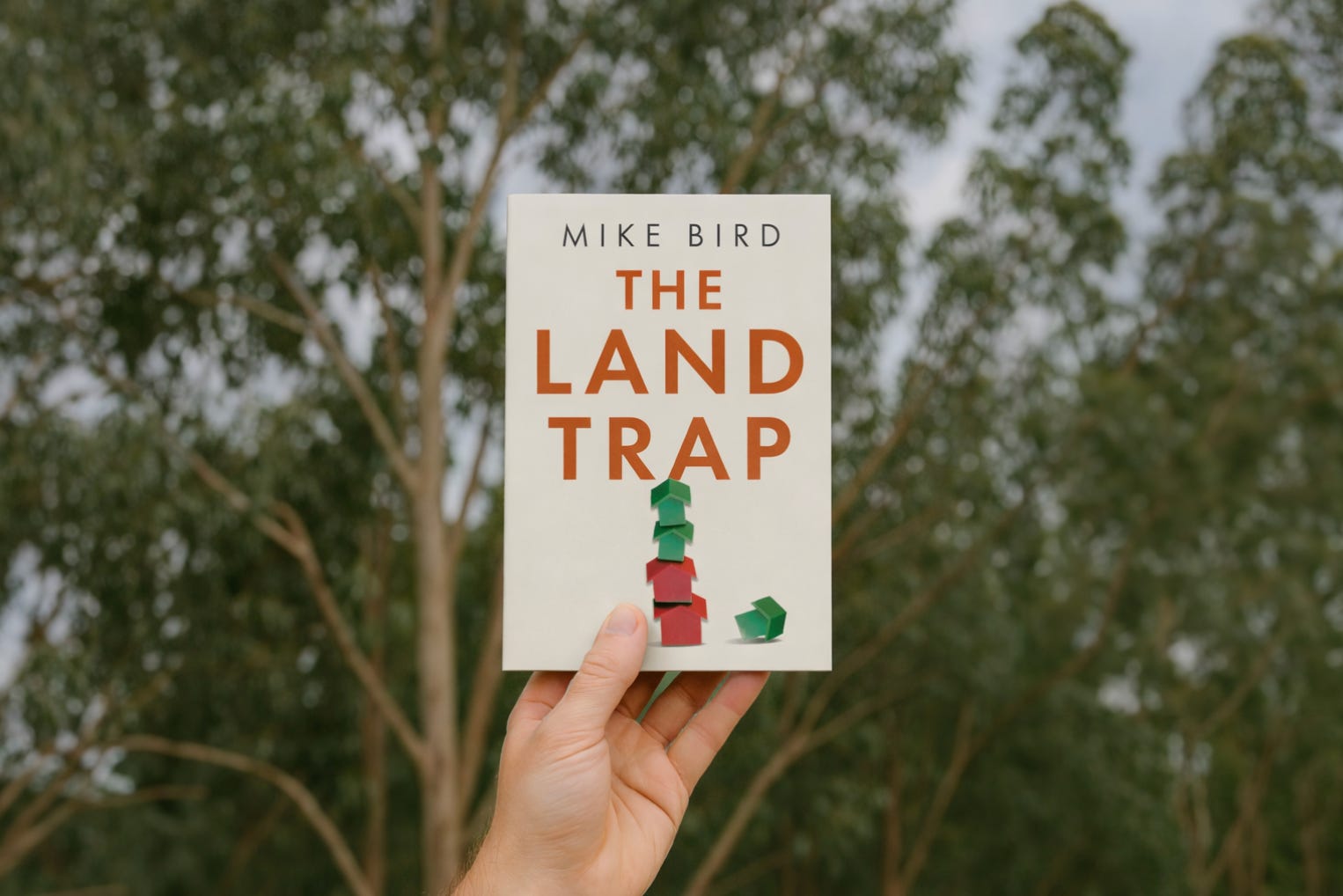
Mike Bird’s new book The Land Trap hit the policy wonk charts (and even the FT long list) in the lead up to Christmas 2025. It explains land is an unique asset class that inevitably skews lives and livelihoods in favour of owners.
The opening premise proposes the immobile and finite nature of land creates a economic environment where property owners capture wealth generated by others.
This idea has been around for a while, but Bird goes further. Once you’re in the land trap, Bird says that policymakers must focus on managing the consequences of this trap, rather than expecting a flight path back to affordability.
Bird describes this by thinking about cities:
The thousands of workers that flow into bustling cities each morning on buses, cars and train are what give the properties in those places their eye-watering rents an exorbitant prices. The same people pay steep rents to live nearby ,often scrimping and saving for decades to acquire some modest share of land wealth for themselves. The windfall from rising land values is reaped by those who has the good fortune to buy it in a particular place, at a particular time, before prices began to rise. It is, for the most part, a game of luck.
Sound a little like Georgism? Henry George, alongside the concept of a single tax gets a good showing in the book. Bird explains that over time land acts as a ‘trap’ that absorbs the financial gains of a developing society.
How we got here
Bird proposed a simple model of three factors for why a land trap develops:
These three crucial factors - the fixed amount of land available, its immobility, and the fact that is does not naturally decay - are what mark it out from every other asset in the world. They explain most of why land assets are still such a store of enormous wealth today, even as its earliest power - are so much less relevant in modern economies and political systems. And they are also why land can be so profoundly dangerous to our collective prosperity today.
This model may well be fairly explanatory… but it only plays out as a sort of arms race when density (read: height) becomes a factor.
In chapter 5, Bird comments on the effects of urbanisation:
Cities across the Anglosphere, From Sydney, to London, to New York, and Vancouver, hosted the political movements that brought land to the centre of political debate. But at the end of the nineteenth century, those booming cities were oddities on the global stage. Most of the world was neither industrial nor urban, and in most of it, the very old models of land ownership persisted. When the guns finally fell silent at the end of the Second World War, less than a third of the world’s population lived in cities at all. As late as 2006, the population of the world as a whole was still more rural than it was urban. Until very recently, the lives of most people across the world would have been relatively recognisable to their ancestors from a thousand years earlier.
Cities may well be the wellsprings of civilisation, but the benefits of agglomeration aren’t equally distributed. Bird summarises the history:
It was the sweat of workers and the innovation of entrepreneurs that made the land increase in value, but they received a much more modest share of the wealth than their idle landlords. Only land, since it was both fixed and immobile, could explain the disparities between such new and tremendous wealth and the crushing poverty with which George was personally acquainted. When any piece of technology or innovation or effort boosted production, landlords simply raised the rents. They needed to do nothing more than collect the income, which was ballooning in the face of the growing urban population. When new infrastructure was built - the roads, bridges, railways and utilities that were being blanketed over urban America - land prices went up, and landlords vacuumed up the benefits, at the expense of the people who built, used and funded those same developments.
This is the outcome of Birds thesis. Land owners are rewarded outsized returns for the activities conducted on their land, increasing the value of the land itself. A self fulfilling prophecy emerges - never to be stopped.
What is to be done?
Bird’s conclusion is as stark as it is scary. Land traps are real, and seemingly irreversible in the short term1. Once an economy becomes addicted to high real estate values and mass homeownership, reform becomes politically and economically perilous.
Bird summarises:
Few places have managed to avoid the pitfalls of the land trap, and none have managed to escape it entirely once the wheels have been set in motion. For nations both rich and poor alike, understanding that the trap exists at all - that land wealth is not like any other wealth, and that it can have pernicious and long-lasting outcomes - is the first step.
So what is to be done? Well firstly, we need to make a judgement call on the claim that buying (relatively cheap) land and not doing much with it encourages more speculative buying. If this is true (and there’s good evidence for it in increasingly dense environments), then the natural follow on outcome is that there is a logical investment strategy to buy land, drive up prices and force out actually useful, value-creating forms of investment (e.g. residential housing or commercial property).
From here, there’s a handful of (at least partial) solutions:
Solution 1: Introduce a land value tax
Instituting a land value tax counters speculation and land banking because it makes holding onto land expensive. In theory, investors stop buying land unless they are able to use the land productively enough to generate more value than it costs to own. The tax rate can be adjusted to equate land yields to returns on other asset classes.
From here, whether it’s developing and selling property, owning rental properties, farming, or through commercial assets - the maths is quite simple. Does the yield outweigh the annual tax?
While some countries (Australia and the UK included) have dipped their toe in this policy arena - namely through vacant property taxes2 - broader land value taxes are a political non-starter.
Solution 2: Radical state led housing
An alternative is to reshape the psyche of just about every western country that home ownership actually isn’t the cornerstone of both the family (and community). Instead, the state is the natural provider of accomodation (at least in dense urban areas).
Good luck with that as a campaign platform.
Bird spends a lot of the book discussing city states like Singapore or Hong Kong3 . These countries may be at an advantage here given their wide sweeping subsidised housing programmes, but it’s their exception that proves the more common rule.
There is a fundamental need for far more state provided housing for the disadvantaged of course, but this is more a of a social welfare policy adjustment, rather than a rewiring of the national psyche round property rights.
Solution 3: Build?
The Land Trap book falls silent on supply side solutions, presumably because you can’t make anymore land. Fair. While this is obviously true, in most dense urban environments you can build up, rather than out.
Building more apartments - especially larger 3 or 4 bedroom apartments - in dense urban areas presents a simple solution. Zoning is often the barrier here (Grattan has been banging this drum loudly) rather than the demand side of the equation, namely stigma against apartment living.
The trouble with this solution is the implementation. Any proposed policy changes to zoning immediately give windfall gains to the incumbent land owners, feeding back into the original land trap. Sure a developer will be happy to sell you a flash 3-bed apartment, albeit at an exorbitant price given the skyrocketing land value.
If there’s one takeaway here, it’s that the land trap is a one-way door. We’re already through the looking glass. Reversing it will be difficult, if not impossible.
The question remains: how do we manage?
Revolution, yes, isn’t normally an option
Incentivising property investors to not book zero cash yield in any given year
ish. Until recently.